Since 2011
Fifteen years of running on roads with memory
Every great race is really a story about a road.
Ours begins in 2011, when Kenyan distance runner Abraham Kosgei stood at historic Fort Marcy in the heart of Santa Fe and imagined a race that would carry runners the way this land has always carried its people: north along the Old Taos Highway, past the Santa Fe Opera and Camel Rock, through the Village of Tesuque and the lands of Tesuque Pueblo, down 1,300 feet into the Rio Grande Valley to Buffalo Thunder in the Pueblo of Pojoaque. Ancestors ran and walked that route for centuries. For nearly a decade, so did we — up to 1,600 of us at a time, to the sound of African drums at the start line, making it one of the most beloved running events in Northern New Mexico.
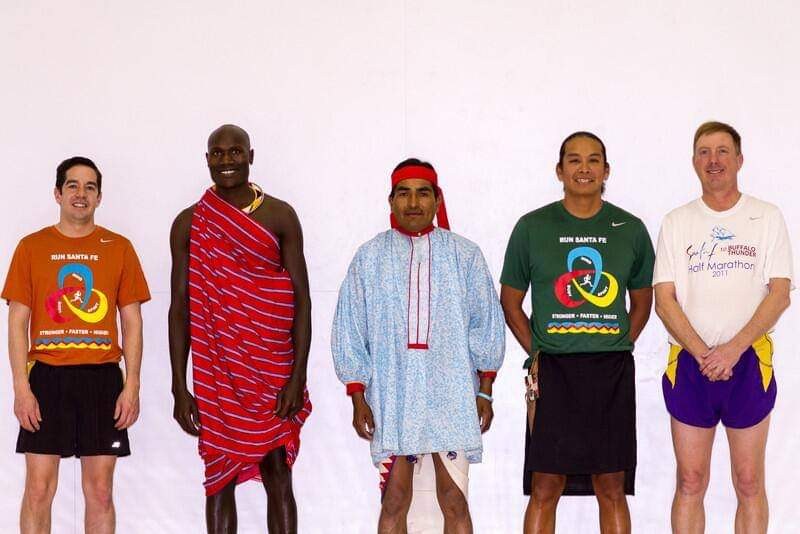
That was the first lesson this race ever taught: in Santa Fe, you don’t build a course. You borrow one — from the Pueblos, from the traders, from the runners who came before.
In 2019, a new chapter began quietly, the way most true things do: a small sunrise run on a foothill trail. No expo, no arch, no crowd. Just runners, thin air, and first light on the Sangre de Cristos. That morning run became the Santa Fe International Half Marathon — reborn under Mwangaza Athletics Club, the Swahili word for enlightenment.
The world stopped in 2020. We came back. In 2022, we honored Indigenous Peoples’ Day by running the classic route one more time — Fort Marcy to Buffalo Thunder, the full descent into the valley — a bridge between the race’s first life and its next one.
Then we turned south to the Old Las Vegas Highway — the original alignment of Route 66, and before that, the final approach of the Santa Fe Trail, where wagon caravans from Missouri made their last push into the city. By our fourth annual in 2025, with Capitol Ford as our title sponsor, the race had grown into a three-day festival of racing, wellness, and culture — runners from 47 states, drums at dawn, custom-made medals in tired hands.
For our fifth annual in 2026, the story arrived where it was always headed.
We run the river.
The Santa Fe River is the reason this city exists. For more than 400 years it connected communities along El Camino Real de Tierra Adentro — the royal road from Mexico City, the oldest European trade route in North America — and for thousands of years before that, it sustained the Pueblo peoples of this valley. By 2007 it had been named America’s Most Endangered River: dammed, dry, forgotten. Then this community did something remarkable. Neighbors knocked on doors for easements. The city and county rebuilt the channel with native willows and cottonwoods instead of concrete. An ordinance now releases living water down the riverbed each year. Mile by mile, Santa Fe brought its river back to life.
On September 20, 2026, we ran that resurrection for the first time, and on September 19, 2027, we run it again. At 7:30 in the morning, the long call of an African kudu horn rises over Romero’s Park on historic Agua Fría — a village older than the United States, named for the cold water itself — and sends runners onto a course that rolls through an opening loop of high-desert farmland, then climbs the river corridor toward the city, turning at 6,883 feet before flowing back down to the finish at Reunity Resources Farm. Not a course borrowed from conquest or commerce this time, but from restoration. Every stride traces a waterway that a community refused to let die.
And that is why this course, of all courses, is ours. Because this race has always run for water. Proceeds support the Kitany Water Project and youth and meal programs in Coach Kosgei’s home village of Matunget, in Kenya’s Rift Valley — where some of the greatest distance runners on earth learned to run beside their own rivers. A runner tracing a rescued river in New Mexico helps a child drink clean water in Elgeyo-Marakwet. One river answers another, across two continents.
Not everything changes with the course. The call of the kudu horn still sends runners off, and the drums still carry the morning. Kids still dye T-shirts indigo with master artist Gasali Adeyemo. Every finisher — half marathon, relay, 10K and 5K alike — earns the same finisher medal, handmade by Maasai artisans; the top three in every age group take home a separate handcrafted medallion from the same artisans. The 3-Amigos Relay still passes its sash. On Saturday the 5K and the new 10K bring whole families out to the farm, and the free Kids Fun Dash brings the youngest runners to Reunity Resources Farm.
Fifteen years. Four courses.
Two continents.
One current running through it all.
This year, we run the river. Come run it with us.